
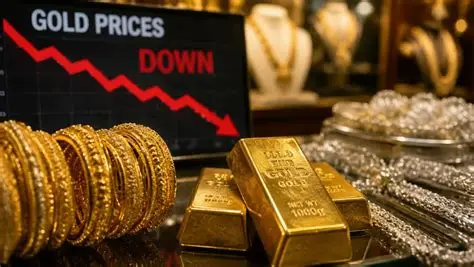
Gold prices are falling mainly because US interest rates and Treasury yields are rising, while the US dollar and crude oil prices are also moving higher. Higher bond yields make interest-paying investments more attractive, while gold does not generate any regular income.
These factors have increased pressure on gold prices and pushed them close to a seven-week low. Spot gold prices fell by more than 3% in late September 2026.
Gold prices have fallen sharply today, with MCX Gold 5 October futures trading at ₹1,47,102 per 10 grams, down ₹3,779 or 2.50%.
For people holding gold, investing through a gold ETF, or planning to buy jewellery, the main question is why gold prices are falling even though geopolitical tensions and inflation concerns are still present.
The main reasons are coming from outside the gold market. US interest rates have moved higher, government bond yields have risen sharply, and a strong US dollar is also putting pressure on gold prices. These factors make gold less attractive because investors can earn better returns from assets that pay interest.
The bigger question for investors is whether this is only a short-term correction or if the overall economic environment has become more challenging for gold.
Why Are Gold Prices Falling Today?
There is no single reason behind today’s fall in gold prices. Three main factors are putting pressure on gold at the same time: higher US interest rates, rising US Treasury yields, and a stronger US dollar. Among these, rising bond yields are having the biggest impact.
The US 10-year Treasury yield increased from 4.96% on September 22 to 5.11% on September 23 and 5.18% on September 24. It remained high at around 5.17% on September 25.
But why do US government bond yields matter for someone investing in gold in India?
The reason is simple. Gold and US Treasury bonds compete for investor money. Gold does not pay any interest, so investors mainly earn when its price goes up. On the other hand, US Treasury bonds offering yields of around 5% provide investors with regular interest income.
So, when bond yields rise, investors may prefer putting their money into interest-paying assets rather than gold. This means investors give up more potential interest income when they choose to hold gold.
This higher opportunity cost is one of the main reasons putting pressure on gold prices today.
Why the 5% US Treasury Yield Matters for Gold Investors
The recent move in the 10-year US Treasury yield puts today’s correction into perspective.
| Date | US 10-Year Treasury Yield |
| September 22 | 4.96% |
| September 23 | 5.11% |
| September 24 | 5.18% |
| September 25 | 5.17% |
From September 22 to September 24, the yield rose by 22 basis points, from 4.96% to 5.18%. This may seem like a small move, but in a market as large as US government bonds, even a change like this can be important.
Real yields also remained high. The 10-year real Treasury yield was around 2.88% on September 22. It continued to rise over the next few sessions and reached about 3.08% on September 25. In simple terms, real yield shows how much return investors can earn from government bonds after taking expected inflation into account.
This is important for gold because gold does not pay any interest or regular income. When government bonds start offering a strong return even after adjusting for inflation, they can become more attractive to investors compared with gold.
So, the fall in gold prices is not only because investors are booking profits. Investors are also getting better returns from other relatively safer assets, which is putting additional pressure on gold prices.
What Could Push Gold Prices Higher Again?
The best way to understand what could happen next is to keep an eye on the same factors that are currently putting pressure on gold prices.
- US bond yields: If the 10-year US Treasury yield stays near or above 5%, gold may continue to face pressure because investors can earn interest from bonds. If yields start falling steadily, some of that pressure on gold could ease.
- Federal Reserve expectations: Investors should not only look at what the Fed has already done, but also what it may do next. If markets start expecting interest rate cuts or easier monetary policy, it could support gold prices.
- US dollar: Gold and the US dollar often move in opposite directions. If the dollar weakens, gold becomes cheaper for buyers using other currencies, which can support demand. A stronger dollar, on the other hand, can put more pressure on gold.
- Geopolitical developments: Rising global tensions or uncertainty can increase demand for gold as a safe-haven asset. However, the impact will also depend on what is happening with bond yields and the US dollar at the same time.
For Indian investors, the USD/INR exchange rate is also important. If the rupee weakens against the dollar, domestic gold prices may stay supported even if international gold prices fall. Similarly, a stronger rupee can reduce some of the gains coming from higher global gold prices.
Key Drivers Behind the Decline
1. Higher U.S. Interest Rates and Treasury Yields
- Gold does not generate interest, so rising yields make bonds more attractive.
- The U.S. Federal Reserve’s tightening path — including rate hikes and expectations of more — increases real yields, reducing gold’s appeal.
- The 10‑year Treasury yield has climbed above 5%, its highest since 2007.
2. Stronger U.S. Dollar
- Gold typically moves inversely to the dollar.
- A stronger dollar, supported by resilient U.S. markets and shifting Fed policy expectations, has created additional headwinds for gold.
3. Rising Crude Oil Prices and Inflation Concerns
- Oil prices have surged above $100 per barrel due to geopolitical tensions, especially the U.S.–Iran conflict.
- Higher oil prices raise inflation risks, prompting expectations of further rate hikes — which again hurt gold.
4. Geopolitical Tensions
- Conflicts involving the U.S., Iran, and Middle East supply routes have pushed up oil prices and strengthened the dollar.
- These factors indirectly pressure gold by reinforcing expectations of tighter monetary policy.
5. Market Positioning and Correction After Record Highs
- Gold hit an all‑time high of $5,405 in January 2026, driven partly by speculative momentum.
- Extreme positioning meant there was “nothing left to buy,” making the market vulnerable to a sharp correction once macro conditions shifted.
- Prices have since fallen about 23% from the peak.
Summary
Gold prices are falling because of several factors working together. Higher interest rates and Treasury yields have made interest-paying investments more attractive, while a stronger US dollar and higher oil prices have added further pressure.
At the same time, geopolitical tensions are keeping markets uncertain. Gold had also reached record highs earlier, so some of the recent fall can be seen as a normal correction after a strong rally.